Agora vs Glean: Which Enterprise AI Search Platform Fits Your Organization?
Why This Comparison Matters
Enterprise AI search has become a critical layer in how modern organizations operate. The ability to surface relevant internal knowledge, automate repetitive tasks, and deploy intelligent agents across teams can mean the difference between 1.8 hours of wasted search time per employee per day and instant answers.
Both Agora and Glean address this problem. But they take fundamentally different architectural approaches that affect your long-term flexibility, data sovereignty, and total cost of ownership.
This comparison is designed to help engineering leaders, CTOs, and infrastructure teams make an informed decision based on technical reality, not marketing.
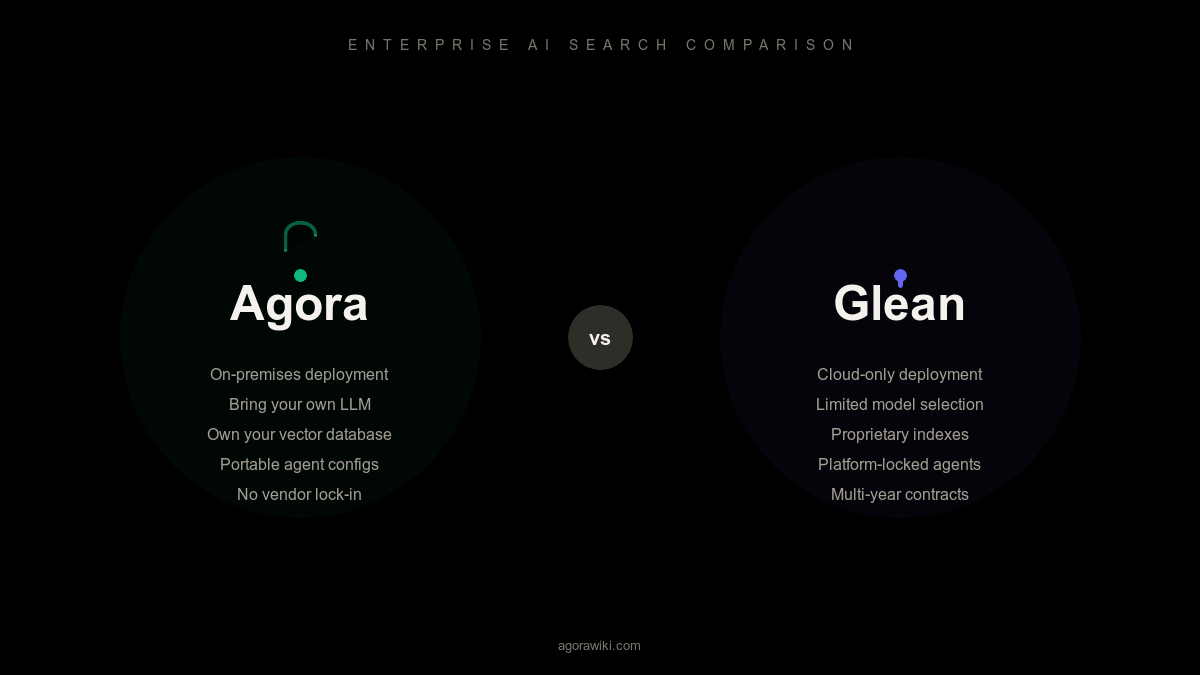
At a Glance
| Capability | 🟢 Agora | 🟠 Glean |
|---|---|---|
| Deployment | On-premises, private cloud, managed cloud | Cloud-only (customer-hosted cloud at best) |
| Air-gapped deployment | ✅ Yes | ❌ No |
| LLM provider | Bring your own (GPT, Claude, Gemini, Llama, Mistral, local models) | Limited to OpenAI, Anthropic, Google within Glean’s platform |
| Vector database | Bring your own (Qdrant, Pinecone, Weaviate, etc.) | Proprietary, non-negotiable |
| Custom agents | Config-based with MCP tools, portable | No-code builder, locked to Glean’s platform |
| Data ownership | Customer owns all infrastructure and data | Data lives in Glean’s proprietary Enterprise Graph |
| Vendor lock-in | ✅ Low (open infrastructure) | ❌ High (proprietary indexes, non-portable agents, multi-year contracts) |
| Target scale | Teams of any size | 500+ employee enterprises |
| Pricing transparency | ✅ Transparent | ❌ Opaque (requires sales engagement) |
| Vertical specialization | Industry-specific agent templates, general enterprise | Horizontal only |
Deployment: Where Does Your Data Live?
Glean
Glean is fundamentally a cloud-native platform. Their default deployment is hosted by Glean on their infrastructure. They offer a “customer-hosted cloud” option where the platform runs inside your AWS, Azure, or GCP account, but there is no true on-premises option.
This means:
- No air-gapped deployments for regulated industries (defense, healthcare, financial services)
- Your data always requires a cloud provider relationship
- Compliance with data residency requirements depends on Glean’s regional availability (AMER, EMEA, APAC)
Agora
Agora offers three deployment models with full parity:
- On-premises: Deploy with a single Helm command. Fully air-gapped. Nothing leaves your network.
- Private cloud: Dedicated tenant on your cloud infrastructure with complete data isolation.
- Managed cloud: Fully managed with auto-scaling for teams that don’t want to self-host.
Key difference: For regulated industries (banking, government, defense, healthcare) the ability to run entirely on-premises with no external data dependencies is not optional. It’s a requirement.
LLM Flexibility: Who Controls the Brain?
Glean
Glean lets administrators select from a curated set of models (OpenAI GPT, Anthropic Claude, Google Gemini) within their platform. They route different tasks to different models: coding to Claude, creative work to Gemini, general reasoning to GPT.
However:
- You cannot bring your own fine-tuned model
- You cannot use open-source models (Llama, Mistral, DeepSeek)
- You cannot self-host an LLM and connect it to Glean
- You rely on Glean’s contractual agreements with model providers (zero-retention), not your own
- Model availability depends on Glean’s roadmap, not yours
Agora
Agora is model-agnostic by design:
- Any commercial provider: GPT, Claude, Gemini
- Any open-source model: Llama 3, Mistral, DeepSeek, Phi, JAIS
- Self-hosted models: Run inference on your own hardware
- AWS Bedrock, Azure AI, GCP Vertex: Use your existing cloud AI agreements
- Switch providers without migration: The retrieval layer is decoupled from the generation layer
Key difference: You can start with OpenAI today, switch to a self-hosted Llama deployment tomorrow, and add Claude for specific use cases - all without changing your data pipeline or agent configurations.
Vector Database: Who Owns Your Search Index?
Glean
Glean uses a proprietary indexing system built on their “Enterprise Graph,” a knowledge graph encoding entities, relationships, and organizational context. This is powerful, but entirely non-portable.
- You cannot export your indexed data
- You cannot choose a different vector database
- If you leave Glean, you lose years of accumulated organizational knowledge encoded in their graph
- The index structure is opaque: you cannot inspect, modify, or extend it
Agora
Agora lets you bring your own vector database:
- Qdrant (default): high-performance, open-source
- Plug in Pinecone, Weaviate, Milvus, pgvector, or any compatible vector store
- Your embeddings, your collections, your infrastructure
- Full visibility into how documents are chunked, embedded, and indexed
- If you leave Agora, your vector data stays with you
Your search index is an asset you own, not a dependency you rent.
AI Agents: Portable vs. Platform-Locked
Glean
Glean offers a no-code agent builder and agent orchestration. Agents can be triggered by events, route tasks between each other, and act autonomously. There’s a shared library of templates.
The limitation: these agents exist only within Glean. They cannot:
- Run outside Glean’s infrastructure
- Be exported to another platform
- Operate independently of Glean’s Enterprise Graph
- Use tools outside Glean’s ecosystem (without custom integration)
Agora
Agora treats agents as configuration:
agent:
  name: "Engineering Knowledge Assistant"
  model: gpt-4.1
  provider: openai
  system_prompt: "You are a technical assistant..."
  tools: [rag_search, web_search, custom_action]
  max_iterations: 5
  triggers: [webhook, schedule]
Agents are:
- Defined as config: version-controlled, auditable, reproducible
- Tool-based via MCP (Model Context Protocol): connect any tool
- MCP server exposure: Agora exposes multiple MCP servers, letting external AI tools (Claude Desktop, Cursor, Copilot) connect to your knowledge base and agent capabilities directly
- Provider-flexible: same agent can run on different LLMs
- Self-hosted or managed: run the orchestration loop yourself or use Anthropic Managed Agents
- Portable: your agent definitions work regardless of where they run
Data Source Integrations
Glean
Glean has a clear advantage in breadth: 100+ pre-built connectors covering CRM (Salesforce, HubSpot), communication (Slack, Teams), engineering (GitHub, Jira), HR (Workday), and more. Their connector library is mature and well-maintained.
Agora
Agora currently supports the most critical knowledge sources:
- Confluence, Notion, Google Drive: core documentation platforms
- AWS S3, GCP Storage, Azure Storage: cloud file storage
- WikiJS: open-source wiki platforms
- File uploads: direct document ingestion (PDF, DOCX, HTML, Markdown, audio, video, images)
- Custom connectors via API
For organizations whose critical knowledge lives in documentation platforms, cloud storage, and internal wikis (which covers the majority of enterprise knowledge management needs) Agora provides comprehensive coverage. Additional connectors are on the roadmap.
Document Processing
Glean
Glean ingests and indexes content from connected sources. Details of their processing pipeline are not publicly documented.
Agora
Agora’s document processing pipeline is transparent and handles:
- PDF: Full extraction with OCR for scanned documents
- Office documents: DOCX, XLSX, PPTX conversion
- Images: Tesseract OCR + TrOCR for handwritten content
- Audio: OpenAI Whisper transcription
- Video: Frame extraction + audio transcription combined
- Markdown/HTML: Direct indexing with structure preservation
- Deduplication: Perceptual hashing to avoid redundant content
The pipeline: Extract -> Convert to Markdown -> Chunk -> Embed (OpenAI text-embedding-3-small, 1536-dim) -> Index in vector DB. Every step is visible and configurable.
Security and Permissions
Glean
- Single-tenant isolated deployments
- Real-time permission enforcement from source systems
- Zero-retention agreements with LLM providers
- Sensitive data detection and remediation
- Agent governance controls
- SOC 2 compliance
Agora
- Per-request audit trail (BigQuery logging)
- RBAC at document, source, and agent level
- SSO via Firebase (OIDC/SAML capable)
- Encryption at rest and in transit
- Org-scoped data isolation (multi-tenancy)
- Feature toggle system for granular access control
- On-premises option: when your security requirement is “data never leaves the building,” only on-prem satisfies it
Key difference: Glean’s security depends on trusting Glean’s infrastructure and their third-party agreements. Agora’s on-premises deployment means security is entirely under your control.
Pricing and Total Cost of Ownership
Glean
Glean does not publish pricing. Based on publicly available contract data:
- Median contract: ~$98,100/year
- Range: $28,500 to $202,000+/year
- Structure: Per-user licensing, multi-year commitments (2-3 years for best rates)
- Hidden costs: Implementation fees, custom integrations, training, 3-7% annual price escalations
- Minimum: Likely 100+ user minimum
- No self-serve option: requires sales engagement
Agora
Agora offers transparent, predictable pricing designed for teams of any size. No surprise escalation clauses, no multi-year lock-in requirements. Contact us for details tailored to your deployment model and scale.
Vendor Lock-In: The Long Game
This is perhaps the most important consideration for any enterprise infrastructure decision. AI search is not a tool you swap out easily. It becomes the knowledge layer your entire organization depends on.
Glean’s Lock-In Vectors
- Enterprise Graph: Your organizational knowledge, relationships, and context accumulate in Glean’s proprietary system. This is non-portable.
- Proprietary indexes: All your document embeddings and search indexes live in Glean’s infrastructure. No export.
- Agent ecosystem: Custom agents built in Glean cannot run elsewhere.
- Enterprise Memory: Behavioral patterns and workflow traces stored in Glean’s system.
- Multi-year contracts: 2-3 year commitments standard, with annual price escalations.
- Switching cost: Leaving means rebuilding your knowledge layer from scratch.
Agora’s Approach
- You own the vector database: your embeddings are yours
- You own the infrastructure: on-prem or your cloud account
- Agent configs are portable: JSON/YAML definitions, not platform-locked
- No multi-year lock-in: month-to-month available
- Standard formats: Markdown chunks, OpenAI-compatible embeddings, standard APIs
Decision Matrix
Choose Glean when:
| Requirement | Why Glean fits |
|---|---|
| 500+ employees, $100K+/year budget | Glean’s pricing model targets large enterprise |
| Need 100+ pre-built connectors immediately | Mature connector library across CRM, HR, engineering |
| Cloud-hosted is acceptable | No compliance need for on-prem |
| Zero infrastructure management | Fully managed, no ops team needed |
| No-code agent building preferred | Visual builder over configuration-as-code |
| Comfortable with long-term vendor commitment | Multi-year contracts for best rates |
Choose Agora when:
| Requirement | Why Agora fits |
|---|---|
| On-premises or air-gapped deployment | Regulated industries, defense, healthcare, finance |
| Bring your own LLM | Open-source, self-hosted, or any commercial provider |
| Data sovereignty required | Your indexes, your infrastructure, your control |
| Avoid vendor lock-in | Portable agents, standard embeddings, no proprietary graph |
| Custom agent workflows | MCP tool integration, webhook triggers |
| Own your AI infrastructure long-term | No dependency on a single vendor’s roadmap |
| Any scale | 10-person team to thousands, no minimums |
The Bottom Line
Glean is a polished, enterprise-grade product with impressive breadth. For large organizations that are comfortable with cloud-only deployment and long-term vendor commitment, it delivers a comprehensive solution.
Agora is built for organizations that believe their AI knowledge infrastructure should be an asset they own, not a service they rent. If you need deployment flexibility, model freedom, data sovereignty, and freedom from lock-in, Agora gives you that without sacrificing capability.
The question is not just “which platform has better search today?” It’s “who controls our knowledge infrastructure in five years?”
Frequently Asked Questions
Can Glean be deployed on-premises?
No. Glean is cloud-only. They offer a “customer-hosted cloud” option where the platform runs in your AWS, Azure, or GCP account, but there is no air-gapped or true on-premises deployment. Organizations in regulated industries (defense, healthcare, finance) that require data to never leave their network cannot use Glean.
How much does Glean cost?
Glean does not publish pricing. Based on Gartner Peer Insights data, median contracts are approximately $98,100/year, with ranges from $28,500 to $202,000+. Multi-year commitments (2-3 years) are standard for the best rates.
Can you use your own LLM with Glean?
Partially. Glean allows selecting from a curated set of models (OpenAI, Anthropic, Google) within their platform. However, you cannot bring your own fine-tuned model, use open-source models like Llama or Mistral, or self-host an LLM connected to Glean.
Is Glean open source?
No. Glean is a proprietary, closed-source platform. All indexes, agents, and the Enterprise Graph are non-portable. If you leave Glean, you lose accumulated organizational knowledge encoded in their system.
More Comparisons
- Agora vs Onyx: Open Enterprise AI Platforms
- Agora vs Guru: Enterprise AI Knowledge Platforms
- Agora vs Greg AI: Knowledge Infrastructure vs Autonomous Operations
Ready to see Agora in action? Book a demo or try the console to explore what’s possible when you own your AI infrastructure.