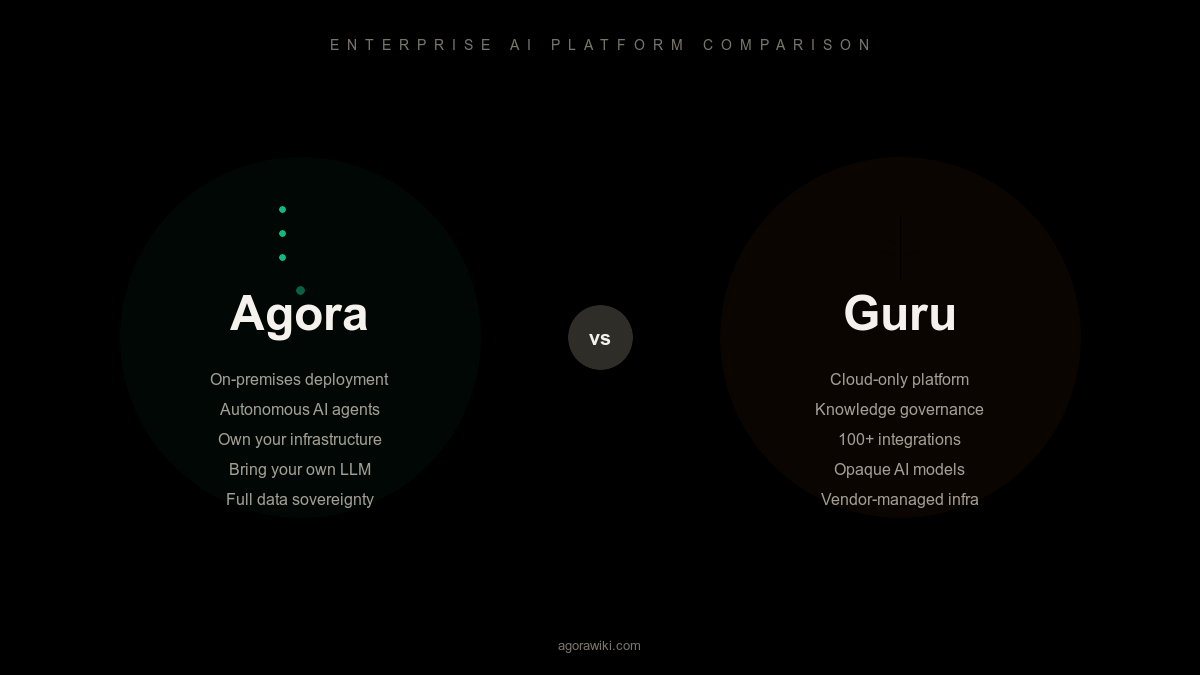
Why This Comparison Matters
Guru and Agora both help teams connect AI to internal knowledge. Both offer enterprise search with AI-powered answers. Both promise to make organizational knowledge accessible and actionable.
But they solve fundamentally different problems. Guru is a knowledge governance platform - it maintains knowledge quality and controls how AI tools access your information. Agora is AI operations infrastructure - it deploys autonomous agents that act on your knowledge in production environments you fully control.
This comparison is for teams deciding whether they need a governed knowledge layer for existing AI tools, or self-hosted AI infrastructure that runs autonomously on their terms.
At a Glance
| Capability | 🟢 Agora | 🟠 Guru |
|---|---|---|
| Core identity | AI operations platform | Knowledge governance platform |
| Deployment | Docker Compose + Kubernetes/Helm | Cloud-only (AWS) |
| On-premises | Yes, fully air-gapped | No |
| AI agents | Autonomous operational agents | Knowledge quality agents only |
| LLM flexibility | Any provider + self-hosted | Opaque, no model choice |
| Vector DB | Bring your own (Qdrant default) | Proprietary, not portable |
| Integrations | 7+ core connectors | 100+ connectors |
| Multi-tenancy | Native org-scoped isolation | Single-tenant |
| Pricing | Transparent | Opaque (sales call required) |
| Wiki/KB | No (focuses on RAG + agents) | Yes (Cards, verification, Team Hubs) |
| MCP servers | Yes (multiple, for external AI tools) | Yes (governed layer for ChatGPT, Claude, Copilot, Cursor) |
The Fundamental Difference: Governance vs Operations
Guru’s approach: Govern how AI reads your knowledge
Guru positions itself as “The Governed Knowledge Layer for Enterprise AI.” The idea is compelling - structure your knowledge once, then let every AI tool (ChatGPT, Claude, Copilot, Cursor) consume it safely via MCP connections. Every answer gets citations. Every access gets audited. Corrections propagate everywhere.
“Correct once, propagate everywhere” - Guru’s core promise
This means Guru becomes the intermediary between your knowledge and all your AI tools. It doesn’t run AI operations itself - it governs what other AI tools can see.
Agora’s approach: Deploy AI that takes action
Agora gives you the AI infrastructure directly. You own the vector database, choose your LLM provider, deploy on your own Kubernetes cluster, and run agents that execute business operations autonomously - triggered by webhooks, schedules, or external events.
Agora doesn’t sit between your knowledge and AI tools. It IS the AI tool - one you fully own and control.
Deployment & Data Sovereignty
| 🟢 Agora | 🟠 Guru | |
|---|---|---|
| Deployment model | Self-hosted (3 options) | Vendor-hosted cloud only |
| Quick start | docker compose up | N/A (SaaS onboarding) |
| Production | helm install agora ./agora-k8s | N/A |
| Air-gapped | Yes | No |
| Data location | Wherever you deploy | AWS (Guru’s regions) |
| Vector DB ownership | Customer owns entirely | Vendor-controlled |
| Disaster recovery | Customer-controlled | Daily backup, 24h RTO |
| Data portability | Full (export embeddings, configs) | Locked to platform |
What this means in practice
Guru: Your knowledge lives on Guru’s AWS infrastructure. You trust them with your data. If you leave, you export Cards (text) but lose all AI indexes, embeddings, and governance configurations.
Agora: Everything runs on your infrastructure. The vector database, the embeddings, the agent configurations, the LLM connections - it’s all yours. Switch providers, migrate clouds, or go fully air-gapped without losing anything.
For regulated industries: Banking, defense, government, and healthcare organizations with strict data residency requirements cannot use Guru. Agora deploys in air-gapped environments with local user management - no external dependencies required.
AI Agents: Quality Maintenance vs Business Operations
This is where the platforms diverge most sharply. Both use the word “agents” but mean completely different things.
Guru’s Knowledge Agents
Guru’s agents are content quality automation:
| Agent Capability | What It Does |
|---|---|
| Auto-verification | Verifies/unverifies Cards based on accuracy signals |
| Staleness detection | Flags outdated content for review |
| Duplicate detection | Identifies and suggests merging similar Cards |
| Gap identification | Finds repeated Slack questions without answers |
| Draft generation | Creates Card drafts from Slack threads |
| Correction propagation | Updates all surfaces when source content changes |
| Call summarization | Extracts themes from recorded calls |
These are valuable for knowledge hygiene. But they don’t execute business operations.
Agora’s Operational Agents
Agora’s agents take action in production:
| Agent Capability | What It Does |
|---|---|
| Webhook triggers | External events fire agent execution |
| Scheduled execution | Cron-like autonomous runs |
| Background operation | Runs without human initiation |
| Multi-step reasoning | Complex chains with tool use |
| Real-time monitoring | Task board with execution streaming |
| Human-in-the-loop | Review and approval before critical actions |
| MCP tool connections | Execute actions via external tools |
The practical difference
Guru agent example: A Knowledge Agent detects that a support article hasn’t been verified in 90 days, flags it for review, and drafts an updated version based on recent tickets.
Agora agent example: A customer sends a message on an external platform. A webhook fires. The agent processes it with full organizational context, drafts a response, and sends it - all in seconds, with no human initiation.
Guru maintains your library. Agora runs your operations.
Knowledge Management & Search
Where Guru excels
Guru is, at its core, a knowledge base with best-in-class maintenance automation:
| Feature | 🟢 Agora | 🟠 Guru |
|---|---|---|
| Built-in wiki/KB | ❌ | ✅ Cards, Collections, Boards |
| Content verification workflows | ❌ | ✅ Expert-assigned, time-based |
| Stale content detection | ❌ | ✅ Automated flagging |
| Duplicate detection | ❌ | ✅ AI-powered merge suggestions |
| Knowledge gap identification | ❌ | ✅ From Slack patterns |
| Team Hubs (intranet) | ❌ | ✅ Department portals |
| Engagement tracking | ❌ | ✅ Read receipts, announcements |
| Browser extension | ❌ | ✅ Chrome, Edge |
If your primary problem is “our knowledge is scattered, outdated, and unreliable” - Guru’s maintenance automation is genuinely innovative. No competitor does knowledge quality this well.
Where Agora excels
Agora focuses on deep content processing and retrieval rather than knowledge creation:
| Feature | 🟢 Agora | 🟠 Guru |
|---|---|---|
| Hybrid search (vector + BM25) | ✅ | ✅ |
| Cross-encoder reranking | ✅ | ❌ |
| PDF with OCR | ✅ | ⚠️ Basic |
| Audio transcription (Whisper) | ✅ | ❌ |
| Video frame extraction + transcription | ✅ | ❌ |
| Handwritten text (TrOCR) | ✅ | ❌ |
| Perceptual hash deduplication | ✅ | ❌ |
| Custom chunking logic | ✅ | ❌ |
| Bring your own vector DB | ✅ | ❌ |
The tradeoff: Guru helps you create and maintain better knowledge. Agora helps you extract intelligence from content that already exists - including formats Guru can’t process (recorded meetings, scanned documents, training videos, handwritten notes).
Integrations
Connector count by category
| Category | 🟠 Guru | 🟢 Agora |
|---|---|---|
| Knowledge bases & docs | 8 | 3 |
| Cloud storage | 5 | 3 |
| Project management | 8 | 0 |
| Customer support | 8 | 0 |
| Sales CRM | 5 | 0 |
| Communication | 3 | 0 |
| Code repos | 2 | 0 |
| HRIS sync | 35+ | 0 |
| File upload | 1 | 1 |
| Web scraping | 0 | 1 |
| Total | 75+ | 8 |
Guru’s integration advantage
Guru’s breadth is real. If your knowledge lives across Salesforce, Zendesk, Jira, Confluence, and Slack, Guru indexes all of it today. The HRIS sync (35+ HR systems) automatically manages roles and permissions as people join, move, or leave.
Agora’s integration philosophy
Agora focuses on fewer but deeper integrations with complete content processing. Rather than indexing metadata and text snippets from 100 sources, Agora fully processes documents including OCR, audio, video, and handwritten content from the sources it connects to.
Important context: Guru’s 100+ integrations include access points (Chrome, Teams, Slack where you search FROM) and HRIS systems (role management). The actual content source connectors number closer to 40. Still a significant advantage over Agora’s 7+.
AI Governance & MCP
Guru’s MCP governance model
This is Guru’s most forward-thinking feature. The premise:
- Your team already uses ChatGPT, Claude, Copilot, and Cursor
- These tools need access to company knowledge to be useful
- But ungoverned access creates compliance and accuracy risks
- Guru becomes the governed layer that feeds all these tools via MCP
| Governance Feature | 🟢 Agora | 🟠 Guru |
|---|---|---|
| MCP server for external AI tools | ✅ Multiple MCP servers | ✅ Governed MCP layer |
| Citation lineage on every answer | ✅ | ✅ |
| AI audit trails | ✅ (internal) | ✅ (across all tools) |
| Permission-aware responses | ✅ | ✅ |
| DLP/Data masking | ❌ | ✅ |
| Zero data retention (AI providers) | ✅ (self-hosted) | ✅ (contractual) |
| AI Agent Center (control plane) | ❌ | ✅ |
The governance tradeoff
Guru’s model is powerful if you want a single control point for all AI tool access. But it creates a new dependency: Guru becomes the single intermediary between your knowledge and all your AI tools. If Guru goes down, all governed AI access stops.
Agora’s model: you expose MCP servers that let external AI tools (Claude Desktop, Cursor, Copilot, custom agents) connect directly to your self-hosted knowledge base. The difference is ownership - Agora’s MCP servers run on YOUR infrastructure. Your data never leaves your network, and you control exactly what’s exposed. Governance by architecture rather than by policy.
LLM & Infrastructure Control
| 🟢 Agora | 🟠 Guru | |
|---|---|---|
| LLM choice | Any provider + self-hosted | Opaque (Guru selects) |
| Model visibility | Full control | No model selection |
| Vector DB | Qdrant default, swap anytime | Proprietary, locked |
| Embedding model | Customer chooses | Guru chooses |
| Infrastructure | Customer’s K8s/Docker | Guru’s AWS |
| Scaling | HPA auto-scaling (2-6 pods) | Vendor-managed |
| Cost control | Own compute, own models | Per-seat pricing (opaque) |
Why LLM flexibility matters
- New models release quarterly. With Agora, you switch instantly.
- Compliance may require specific providers. With Agora, you choose.
- Self-hosted models keep data on-premises. With Agora, you run Llama, Mistral, or any model locally.
- With Guru, you trust their model selection. You can’t switch, benchmark, or self-host.
Enterprise Features
| Feature | 🟢 Agora | 🟠 Guru |
|---|---|---|
| SSO (SAML/OIDC) | ✅ Included | ✅ Included |
| SCIM provisioning | ✅ | ✅ |
| Custom roles & RBAC | ✅ Included | ✅ |
| IP whitelisting | ✅ (infra-level) | ✅ |
| Audit logs | ✅ | ✅ |
| Multi-tenancy | ✅ | ❌ |
| Local user accounts (air-gapped) | ✅ | ❌ |
| HIPAA (BAA) | ⚠️ Self-hosted compliance | ✅ BAA available |
| SOC 2 Type II | ⚠️ Customer-controlled | ✅ Annual audit |
| HRIS auto-provisioning | ❌ | ✅ (35+ systems) |
| DLP/Data masking | ❌ | ✅ |
Compliance philosophy
Guru: Holds certifications (SOC 2, HIPAA, GDPR) and manages compliance on your behalf. Simpler if you trust a vendor to handle it.
Agora: Self-hosted means you inherit your own infrastructure’s compliance posture. If your Kubernetes cluster is already SOC 2 / FedRAMP / ITAR compliant, Agora inherits that. Maximum control, but you manage it.
For healthcare/finance: Guru offers BAA and SOC 2 out of the box. Agora offers self-hosting that meets any compliance framework - including ones Guru can’t serve (FedRAMP High, ITAR, classified environments).
Pricing Transparency
| 🟢 Agora | 🟠 Guru | |
|---|---|---|
| Public pricing | Yes | No |
| Self-serve signup | Yes (Docker Compose) | No |
| Free tier | Docker Compose (unlimited) | No |
| Pricing model | Transparent tiers | ”Platform + Expertise” bundle |
| How to buy | Self-serve or sales | Sales call required |
| Contract structure | Flexible | Likely annual+ |
What Guru’s pricing includes
Guru bundles “Platform + Expertise + Infrastructure” - meaning you pay for the software, a dedicated AI & KM strategy team, and governance infrastructure. According to Gartner Peer Insights, pricing starts at $25/seat/month (billed annually), suggesting high-touch enterprise pricing in the tens of thousands annually for larger teams.
What Agora’s pricing includes
Start free with Docker Compose. Scale to production Kubernetes. All enterprise features (RBAC, SSO, multi-tenancy, agents) are included regardless of tier. No feature gating.
Decision Matrix
Choose Guru when:
| Requirement | Why Guru fits |
|---|---|
| Knowledge quality is your core problem | Verification workflows, staleness detection, gap identification |
| You need to govern existing AI tools | MCP connections to ChatGPT, Claude, Copilot, Cursor |
| 40+ integrations needed today | Salesforce, Zendesk, Jira, Confluence, Slack, and more |
| HRIS-driven provisioning | 35+ HR systems for automatic role management |
| Team intranet/portals needed | Team Hubs, announcements, engagement tracking |
| Cloud-hosted is acceptable | No on-prem requirement, comfortable with vendor hosting |
| Want a managed compliance story | SOC 2, HIPAA BAA out of the box |
| Browser extension delivery | Chrome/Edge in-workflow knowledge surfacing |
Choose Agora when:
| Requirement | Why Agora fits |
|---|---|
| On-premises / air-gapped required | Full self-hosting with local user management |
| Autonomous AI agents needed | Webhook triggers, scheduled execution, background operation |
| Data sovereignty is non-negotiable | Own your vector DB, embeddings, LLM, and configs |
| Production K8s deployment | Helm charts, HPA auto-scaling, rolling updates |
| LLM flexibility required | Any provider, self-hosted models, swap anytime |
| Multi-tenant architecture | Multiple orgs/clients from one deployment |
| Rich content processing | Audio, video, OCR, handwritten text extraction |
| Transparent pricing | Know what you pay before talking to sales |
| Regulated industry (defense, govt) | Air-gapped, no external dependencies |
| Want to own your AI stack | No intermediary, no vendor lock-in |
The Bottom Line
Guru and Agora serve teams at different stages of their AI journey with different operational requirements.
Guru is for organizations that already have AI tools everywhere (ChatGPT, Copilot, Cursor) and need to govern that usage - ensuring every AI answer is accurate, cited, and permission-aware. It’s also excellent if your primary challenge is knowledge hygiene: keeping documentation fresh, verified, and discoverable. It’s a knowledge management tool that has evolved into an AI governance layer.
Agora is for organizations that need AI infrastructure they own and control - running autonomous agents in production, processing complex content types, deploying on their own terms (including air-gapped), and serving multiple tenants from a single platform. It’s not a wiki or a governance layer. It’s the operational AI itself.
The question: Do you need to govern how AI reads your knowledge? Or do you need to deploy AI that acts on it - on infrastructure you own?
Frequently Asked Questions
Can Guru be deployed on-premises?
No. Guru is a cloud-only SaaS platform hosted on AWS. There is no self-hosted or air-gapped deployment option. Organizations with strict data residency requirements (defense, government, certain healthcare and finance contexts) cannot use Guru.
Is Guru open source?
No. Guru is a proprietary, closed-source platform. Your knowledge, embeddings, and governance configurations are stored on Guru’s infrastructure and are not fully portable if you leave the platform.
How much does Guru cost?
Guru does not publish transparent per-seat pricing on their website. According to Gartner Peer Insights, pricing starts at $25/seat/month billed annually. Their model bundles “Platform + Expertise + Infrastructure,” which suggests enterprise contracts typically run in the tens of thousands annually.
What AI models does Guru use?
Guru does not allow you to choose or bring your own LLM. The AI models used for search and knowledge agents are selected by Guru internally. You cannot self-host models, use open-source alternatives, or switch providers independently.
More Comparisons
- Agora vs Glean: Enterprise AI Search
- Agora vs Onyx: Open Enterprise AI Platforms
- Agora vs Greg AI: Knowledge Infrastructure vs Autonomous Operations
Ready to deploy AI you own? Book a demo to see Agora’s autonomous agents and self-hosted infrastructure in action.