Agora vs Greg AI: Enterprise Knowledge Infrastructure vs Autonomous Operations
Why This Comparison Matters
The enterprise AI market is splitting into two distinct layers: knowledge infrastructure (retrieve, ground, and govern access to enterprise data) and operations execution (act on that data, automate workflows, manage conversations).
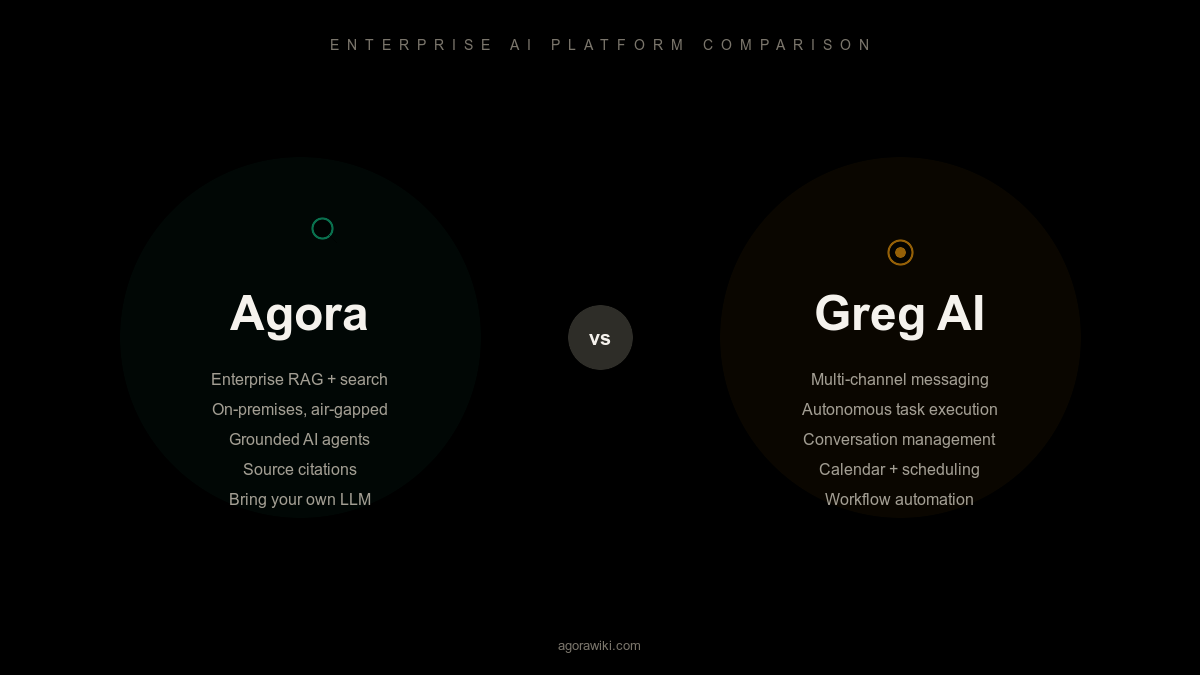
Agora and Greg AI represent these two layers. Agora provides the retrieval and grounding layer - enterprise search, RAG, and AI agents that reason over your organizational knowledge. Greg AI provides the execution layer - an autonomous AI manager that drives conversations, creates tickets, and runs workflows across messaging channels.
Understanding which layer you need first - and how they relate - helps engineering leaders, CTOs, and operations teams avoid building on the wrong foundation.
At a Glance
| Capability | 🟢 Agora | 🟠 Greg AI |
|---|---|---|
| Primary function | Knowledge retrieval + AI agents | Conversation management + task execution |
| Enterprise search (RAG) | ✅ Core strength (hybrid retrieval, reranking) | ❌ Not offered |
| Data source connectors | ✅ Purpose-built (Drive, Confluence, Notion, S3, Azure) | ⚠️ Generic via MCP |
| Autonomous agents | ✅ Multi-step, tool-use, configurable | ✅ Core focus (ops execution) |
| On-premises deployment | ✅ Single Helm command, fully air-gapped | ⚠️ Enterprise plan only |
| Multi-channel messaging | Slack, web chat | ✅ 11+ channels (WhatsApp, Teams, Telegram, etc.) |
| Calendar/scheduling | ❌ Not offered | ✅ Built-in |
| Ticket management | Via agent integrations | ✅ Native auto-detection and routing |
| LLM flexibility | ✅ Any provider, self-hosted, BYO model | ✅ Cloud + self-hosted models |
| Data sovereignty | ✅ Full air-gap, data never leaves network | ⚠️ GDPR claims, on-prem enterprise only |
| Pricing | Per deployment | Per conversations/month (starts 99 EUR/mo) |
| Company maturity | Production deployments | Early access (2-10 employees) |
Architecture: Two Different Layers of the AI Stack
The fundamental difference between Agora and Greg AI is not feature-by-feature - it’s architectural.
Greg AI: The Execution Layer
Greg AI sits at the top of the stack. It connects to messaging channels (WhatsApp, Slack, Teams, email), listens to conversations, and takes autonomous action: creating tickets, scheduling meetings, sending follow-ups, running workflows.
Its value proposition is operational automation:
“Stop wasting time managing your tools: let Greg AI orchestrate your success.”
This means Greg AI assumes your data and knowledge are already accessible, organized, and correct. It orchestrates on top of existing systems rather than building a knowledge foundation.
Agora: The Knowledge Infrastructure Layer
Agora sits at the foundation of the stack. It ingests enterprise data from multiple sources, processes it (OCR, transcription, chunking, embedding), builds a searchable knowledge layer, and deploys AI agents that reason over that knowledge with source citations.
Its value proposition is grounded intelligence:
Deploy AI agents that can find, reason about, and act on your organizational knowledge - with full traceability to source documents.
This means Agora solves the prerequisite problem that execution-layer tools depend on: reliable access to accurate enterprise knowledge.
Knowledge Retrieval: The Foundation Problem
Greg AI
Greg AI does not offer enterprise search or RAG. It is not designed to ingest documents, build knowledge indexes, or retrieve grounded answers from internal data.
When Greg AI needs information to complete a task, it relies on whatever is available through its connected channels and MCP integrations. There is no dedicated knowledge retrieval system, no hybrid search, no reranking, and no source citations.
This creates a structural limitation: autonomous agents that cannot reliably access accurate organizational knowledge will produce unreliable outputs. The more complex the task, the more this matters.
Agora
Knowledge retrieval is Agora’s core:
- Hybrid search: Dense vector + BM25 full-text + reciprocal rank fusion + cross-encoder reranking
- Multi-format ingestion: PDF, DOCX, HTML, Markdown, spreadsheets, images (OCR), audio (transcription), video
- Source citations: Every answer links back to the source document
- Permission-aware: Results respect role-based access control
- Multiple connectors: Google Drive, Confluence, Notion, AWS S3, Azure Blob, file uploads
Without reliable retrieval, autonomous agents operate on incomplete or stale information. Knowledge infrastructure is not optional - it’s the foundation that makes agent execution trustworthy.
Autonomous Agents: Different Approaches
Greg AI
Greg AI’s agents are conversation-oriented. They:
- Monitor messaging channels for follow-up opportunities
- Create and route tickets automatically
- Execute workflows defined in plain language
- Send reminders and manage calendars
- “Speak up” proactively (3/day on Pro plan)
The trigger model is conversation-driven: Greg watches channels, detects patterns, and acts. This works well for service businesses handling high volumes of customer/team communication.
Limitation: Agent behavior is tied to Greg’s platform. You cannot export workflows, self-host the agent runtime independently, or compose agents with external tooling beyond what Greg provides.
Agora
Agora’s agents are knowledge-grounded and infrastructure-level:
- Agent definitions as config - system prompt, tool bindings, retrieval scope, guardrails
- Multi-step execution with tool-use chains (iterative reasoning until completion)
- Two runtime modes: Self-hosted (runs on your infrastructure) or Managed (Claude + MCP)
- MCP Server exposure - Agora exposes MCP servers so external AI tools (Claude Desktop, Cursor, ChatGPT, custom agents) can connect and use Agora’s knowledge as a tool
- Scoped access control per agent
- Real-time streaming for execution monitoring
Agora agents are portable, composable, and infrastructure-independent. They don’t just execute tasks - they reason over your knowledge base with full traceability.
Deployment & Data Sovereignty
Greg AI
- Default: Cloud SaaS (100% cloud native)
- Enterprise plan: On-premise or private cloud deployment available
- Compliance claims: GDPR, ISO, HDS (on enterprise plan)
- Self-hosted models: Supported via Ollama, Hugging Face
The on-premise option exists but is limited to the most expensive tier. No evidence of air-gapped deployments or defense/government-grade isolation.
Agora
Agora offers three deployment models with full feature parity:
- On-premises: Single
helm install. Fully air-gapped. Nothing leaves your network. - Private cloud: Dedicated tenant with complete data isolation.
- Managed cloud: Fully managed with auto-scaling.
helm install agora agora/agora-platform \
  --set global.domain=ai.yourcompany.internal \
  --set llm.provider=ollama \
  --set llm.endpoint=http://ollama.internal:11434
For regulated industries - banking, defense, government, healthcare - true air-gapped deployment is not a feature upgrade. It’s a requirement. Agora delivers this on every plan.
Multi-Model Support
Both platforms support multiple AI models, but with different emphases.
Greg AI
Greg AI claims to select the “best model for each task” automatically:
- Cloud APIs: OpenAI, Anthropic, Google, Mistral, DeepSeek
- Self-hosted: Llama, Mixtral, Gemma, Qwen, DeepSeek via Ollama or Hugging Face
- Custom models on Enterprise plan
Agora
Agora is fully model-agnostic:
- Any commercial provider (GPT, Claude, Gemini)
- Any open-source model (Llama, Mistral, DeepSeek, Phi)
- Self-hosted inference on your own hardware
- AWS Bedrock, Azure AI, GCP Vertex - use existing cloud agreements
- Switch providers without changing pipelines or agent configs
Both platforms offer model flexibility. The difference is control: with Agora, you own the inference infrastructure and can swap models without platform dependency.
Messaging & Channel Coverage
This is where Greg AI has a clear advantage.
Greg AI
11+ messaging channels natively supported:
- WhatsApp, Messenger, Instagram, Telegram, Discord
- Slack, Microsoft Teams
- Outlook, Gmail, Google Chat
- Calendar integration
Greg AI was purpose-built for multi-channel conversation management. If your primary need is unifying communication across consumer and enterprise messaging platforms, Greg covers more ground.
Agora
- Slack integration
- Web chat interface
- MCP protocol for programmatic access
Agora focuses on enterprise knowledge channels rather than consumer messaging. Organizations needing WhatsApp/Instagram/Telegram unification will find Greg AI more suitable for that specific use case.
Pricing & Enterprise Readiness
Greg AI
| Plan | Price | Users | Conversations/mo |
|---|---|---|---|
| Starter | 99 EUR/mo | 3 | 1,000 |
| Advanced | 399 EUR/mo | 12 | 5,000 |
| Pro | 699 EUR/mo | 25 | 15,000 |
| Enterprise | Custom | Unlimited | Custom |
Important considerations:
- Usage is metered by conversations/month - scaling costs can be unpredictable
- Additional conversations sold as token packs (19 EUR per 1,000)
- Currently in “early access” - no public GA release
- 2-10 employees (LinkedIn) - limited support capacity
- No public customer case studies or enterprise references
Agora
- Per-deployment pricing (not per-conversation)
- Predictable costs regardless of usage volume
- Production deployments with established customers
- Full support for enterprise requirements (SSO, audit, compliance)
Conversation-based pricing can surprise at scale. A busy team of 25 on Greg’s Pro plan hitting 15,000 conversations may need to purchase additional packs - making costs hard to predict month-over-month.
When to Choose Each
Choose Greg AI when:
- Your primary problem is multi-channel communication overload across WhatsApp, email, Slack, and social
- You need a proactive AI that initiates follow-ups and manages conversations
- You’re a service business (hospitality, retail, healthcare) handling high message volumes
- You want quick operational automation without building infrastructure
- You’re comfortable with a cloud-first, early-stage product
Choose Agora when:
- Your primary problem is enterprise knowledge access - finding information scattered across Drive, Confluence, Notion, and internal systems
- You need AI agents that reason over your organizational knowledge with source citations
- You operate in a regulated industry requiring on-premises, air-gapped deployment
- You need data sovereignty - data must never leave your network
- You want portable, composable AI agents that integrate with external AI tools via MCP
- You need a production-ready platform with established enterprise deployments
Choose both when:
- You need execution automation (Greg) grounded in reliable enterprise knowledge (Agora)
- Your agents need to both act autonomously and retrieve accurate information to inform those actions
- You want multi-channel messaging (Greg) backed by enterprise-grade RAG (Agora)
The Bottom Line
Greg AI and Agora are not direct competitors - they solve different problems at different layers of the enterprise AI stack.
Greg AI is betting that organizations want an AI that does the work: managing conversations, creating tickets, running workflows. This is a compelling vision, but execution without reliable knowledge access is unreliable execution.
Agora provides the knowledge foundation that makes autonomous action trustworthy: grounded retrieval, source citations, permission-aware access, and portable agent infrastructure.
For organizations evaluating both: start with the layer that solves your bottleneck. If your team spends hours searching for information, deploy knowledge infrastructure first. If your team drowns in messages across channels, operational automation addresses the immediate pain.
The strongest deployments will combine both: knowledge infrastructure providing the reliable foundation, with execution layers operating on top of trusted, grounded information.
Frequently Asked Questions
Is Greg AI production-ready?
Greg AI is currently in early access. According to LinkedIn, the company has 2-10 employees and no public customer case studies or enterprise references are available. Organizations requiring proven production deployments should evaluate carefully.
Can Greg AI retrieve information from internal documents?
No. Greg AI does not offer enterprise search, RAG, or document ingestion. It operates on information available through connected messaging channels and MCP integrations. There is no dedicated knowledge retrieval system, hybrid search, or source citation capability.
How much does Greg AI cost?
Greg AI uses conversation-based pricing starting at 99 EUR/month (Starter: 3 users, 1,000 conversations). The Pro plan costs 699 EUR/month for 25 users and 15,000 conversations. Additional conversations are sold as token packs at 19 EUR per 1,000.
Can Greg AI be deployed on-premises?
On-premises deployment is listed as available only on their Enterprise plan. There is no evidence of air-gapped deployments or government-grade isolation. The default deployment is cloud-only SaaS.
More Comparisons
- Agora vs Glean: Enterprise AI Search
- Agora vs Onyx: Open Enterprise AI Platforms
- Agora vs Guru: Enterprise AI Knowledge Platforms
Ready to deploy knowledge infrastructure you own? Book a demo to see Agora’s enterprise RAG and autonomous agents in action.